The stuff of Dogs and Prophets

Ubud, Bali, language training week 1 of 12…

So I was having trouble falling asleep the other night – something was bugging the dog next door, and he decided to share those concerns with us by barking intermittently for a few hours while I tossed and turned.

Now, I readily admit that this might be a rather strange phenomenon, but I find that the twilight sleep zone (probably not its technical name) often becomes a time of theological reflection for me.  (Some of you are nodding at this point and thinking, ‘aha, the reason for his wacked theology suddenly appears…’)

So theology and barking dogs.  I figured that a good way of getting to sleep while Barky did his thing was to somehow make the yapping fade into the background noise filtering into my room; the humming of the fan, the croaking of the frogs in the rice paddy over the wall; the whirr-tick-tick-whirr-tick-whirr-tick-tick of the leaking pressure pump; the motorbike wandering past.  If I could somehow fade the barking into that part of the evening’s soundtrack, it might even lull me to sleep.  The trick is to not focus on it, and before long, the barking is just white noise.

[Start strange theological reflection].  Leap with me here from barking dogs to the prophetic role of the Church: I’m convinced that a lot of the time we use the dog-bark-to-white-noise conversion on those who argue that we should stand against injustice; who say that those of us who call ourselves followers of Jesus must not remain silent when injustice occurs; those who keep yapping on about refugees and world peace without violence and corporate tax dodging and rising inequality and ethical investing and climate change and yap-yap-yap-bark-whirr-tick-tick-brmmmm-[snore].

We fade their voices into background noise, morph them with the croaking of the hippies in the forest over the wall, write them off as ‘leftist’ or utopian or lump them with our political opponents.

Because if we can do that, we can maintain the comfortable, knowable, boundaried walls of the status quo.

But if we do that – as followers of Jesus – we also need to ignore or (at very least) significantly play down the ‘utopian’ ideology and practice of Jesus who drew from and perfected the tradition of the Old Testament prophets.

I believe much of the Australian Christian community has lost its prophetic voice.  We don’t just ignore the barking of those mentioned above – we’ve forgotten how to bark ourselves.  And so for my final paper of the MTD, I wrote a paper on those Abraham Heschel dubbed ‘some of the most disturbing people around’.  If you are interested in how the prophetic tradition in the Bible might shape the way in which Christians address issues of injustice, you might appreciate this one; if you think Christians should always honour the law of the land, stay out of politics and keep their heads low, let me tempt you with pages and pages of cannon fodder for the next time we meet (honestly, I’d be particularly keen to hear your thoughts if and where you think I’m off the rails).

Have a read of it here.  I’d be super keen to hear any critiques large or small; it is very helpful for me to hear differing opinions as I learn and grow in my walk with Jesus.

Doggedly and prophetically yours,

Clint.

Posted in Uncategorized | 3 Comments

Fire him by Christmas

In this line of work, it’s easy to get caught in a web of cynicism that binds you tight, wondering whether you’re actually making any difference, any headway against the monster of poverty.  It can be difficult to sleep when you add up the costs of flights, accommodation and food, and weigh that against the distance it could go in buying seed or pumps for hungry and thirsty people.

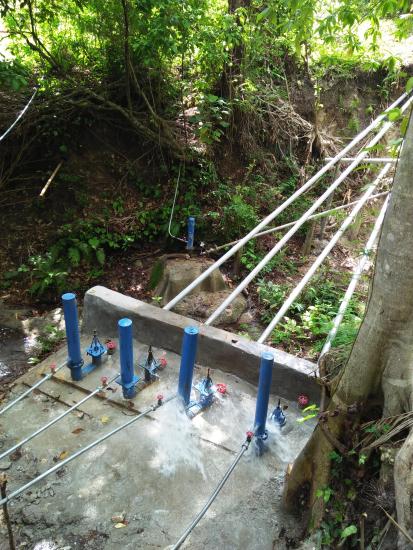
But this past week, we had the (strangely) wonderful experience of being made partially redundant.  We had been asked to look at assisting a community with another hydram.  Their community had expanded significantly in recent times, and water was running short for these folks on a hill.  So we arrived, armed with GPS, altimeters, sunglasses and clipboards – a perfect picture of external consultants, experts of nothing local.  We made our way down to the new hydram location, and found not one, but four hydrams plodding along, clicking and clacking, spraying their water and doing their thing.

And our chuckle was added to their thumping and splashing, a beautiful cacophony, an unusual orchestra.  We laughed at our shallow importance and our small, meagre efforts; and we smiled with joy at the Good News in front of us.  We gave thanks for President Jokowi and his rural agenda, we stood amazed at the impact of government done well.

Later we re-climbed the hill to discuss where-to-next, and were greeted by a rusted ambulance with no sirens or lights flashing.  A mother had given birth that morning to a still-born, and so we sat in silent reverence while her cries and the cries of her family rang out.  Poverty doesn’t dull the senses to heartache; it just makes it a more regular experience.

So celebrate with me our partial redundancy this past week, and keep working – in the multiplicity of ways that you already are – towards that day ‘when God himself will wipe every tear, and death will be no more.’

Sack me by Christmas, I pray.

IMG20171211092359

A metaphoric picture of the difference a small NGO and a government can make; the small hydram in the background was part of Amos Aid’s previous assistance.
Posted in Uncategorized | 1 Comment

I wish for more mid-week Church services

I didn’t ask her name, so let’s call her Gereja. She’s slightly stooped, white-haired, quite frail, her right eye a cataract, her left leg limping – probably in her eighties, an old lady for sure.
We were travelling from Waimarang near the Eastern coast of Sumba, to Nggongi near the south – about 70kms, a 3-4 hour journey due to the rough condition of the road. I arrived earlier than my companions because I was travelling by motorbike, the others by 4wd; I get car sick on the bumpy, winding roads.
And so I stopped to wait at the only place I knew in Ngonggi – the house where the well liners were being made. No-one was home and the place was locked up, so I stood there in the blazing mid-day sun, a bit tired and sore, thirsty, hot and rattled from the hours on the road, a little confused as to what I should do, where I should wait; a gangly, pale-barked tree wilting in a brown, burnt landscape.
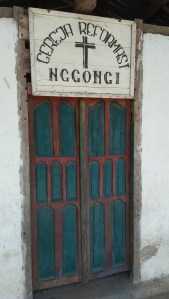
Gereja beckoned me from her house, and we shook hands outside the red, locked doors of the local church. She sent her grand-daughter scurrying to fetch me a chair, and Gereja shuffled off and returned ever so slowly under the burden of a small table. She smoothed a worn table cloth and invited me to share some siri – bettlenut – with her.
I was only there for 15 minutes or so, but experience tells me that Gereja would have willingly prepared a meal, kept me watered and given her best bed if I had decided to stay the night. She didn’t know my name, I didn’t speak her language, she didn’t know why I was there, who I’d come to visit, how long I’d be staying, whether I’m friend or enemy, my political or religious preferences. She just welcomed this ‘stranger in the land’.
She’s slightly stooped, white-haired, quite frail, her right eye a cataract, her left leg limping. But let’s call her Gereja* because she is a beautiful metaphor for what the Church can be – despite its cataracts and limps – on a proverbial Wednesday in the back streets of anywhere, her unconditional hospitality juxtaposed by the official doors of Christianity that are red and too often locked when strange people need a welcoming place of shelter.

When I grow up, I want to be just like the Gereja I encountered in Nggongi.


*Gereja means ‘church’ in Bahasa Indonesia

IMG-26523a557e4753fce032e27b607d0586-V

Posted in Uncategorized | 4 Comments

A Prayer for Damascus Roads

During a recent devotion we were encouraged to write a prayer of lament.  I have found lament to be a very helpful way of holding the many paradoxes that arise as I attempt to follow Jesus as a broken person in a broken world.  Yet lament is (often) strangely maligned in many Christian communities.  Anyway – here’s a wee lament in hopes that it might encourage you to pray/write/yell your own.

Oh Lord

I claim to love your earth,

But I rape it with consumption.

My shirts stain Bengali rivers,

My appetite, Brazillian forests.


I claim to love your people,

But I perpetuate slave-labour,

I encourage and disparage,

I build-up and tear them down.


I’m a walking paradox,

On a rope across an ocean

Of hypocrisy in which I often bathe.

Pointing fingers at injustice –

Always outwards, sometimes in.


But you O Lord

Loved David

Post Uriah,

Called Jonah

Post sea-creature,

Sent disciples

Post desertion.


Blind me daily on Damascus roads

That your life in greater measure

Might be brought here

On this day

And at this minute:


Always inwards, always out.

Posted in Uncategorized | 6 Comments

What only the poor can teach

This past weekend ACHEA – the Australian Christian Higher Education Alliance – held their inaugural conference in Parramatta west of Sydney (shout-out to Rayna, the wonderful Airbnb host who saved me from a baguette-and-butter dinner with a delicious home-cooked meal!).  Eastern College – the mob I’m doing my Masters through – is part of ACHEA, and I was encouraged by my course coordinator to submit a paper for presentation at the conference.  While much of the conversation was well above my head and on a topic I am unfamiliar with (delivering higher education), it was a helpful and very gracious introduction for me into the world of academia.

The paper I submitted was accepted, and so I presented a paper called ‘what only the poor can teach’ – a potentially provocative title and topic for the Christian Higher Education scene, asking the question whether current modes of educational delivery at Christian campuses align with God’s apparent preference for revealing himself in the biblical narrative through the people we’d typically pick last.  This paper was based on a previous small study I had undertaken called the road to transformation, a one way street?

The feedback I received from those present was encouraging and helpful; it was suggested that I do some reading on ‘grounded theology’ and dig into some of Rene Girard’s work on the concept of ‘scapegoating’.  I also received an offer to co-author a journal article, and so I need to do some thinking about whether the academic world is something I have something to contribute to.

Anyway.  It was a helpful introduction for me into the world of academia; they’re a highly intelligent, deep-thinking, well-read but gracious mob – well at least these guys were anyway 🙂  Have a read of this if the intersection of theology, modes of education and God’s self-revelation interest you: What only the poor can teach

Posted in Uncategorized | 3 Comments

Reforestation through the planting of crosses

So I’m in my final semester of my masters studies in ‘transformational development’ through Eastern College of Australia.  The course has been profoundly helpful on a number of levels: the space to explore the interaction between theology and community development, the opportunity to sit under teaching from people with different cultural backgrounds and perspectives, and the encouragement of studying with folks from a host of other countries doing similar work.  I’m going to miss it when I’m done!

Last semester we did a unit on climate change, particularly looking at the impact it has on poor communities who have contributed the least to climate change but are ironically the most vulnerable to the impacts of climate change.  This unit has probably hit me the hardest and moved me the most.

Evangelical Christians have typically been found in the denial camp on climate change, and we are not leading the way on this issue despite having clear biblical mandates to look after the earth and love our global neighbours through it.   The burden of responsibility lies heavily on those living in industrialised nations like Australia, and yet we seem more concerned about maintaining our lifestyles than addressing this issue.

And so I chose to look at the biblical concept of Christians ‘participating in the redemptive suffering of Jesus’, and how that might shape the response of rich Christians like myself to climate change.  We hold that the cross is at the centre of our theology and lives, and we regularly talk about ‘taking up our cross to follow Jesus’, but my concern is that we often empty the cross of it’s power by spiritualising and sanitising its consequences.  My question is essentially, what kind of cross are we carrying and what might it look like to ‘take up our cross’ on the issue of climate change?

If you’re concerned about climate change and are interested in the intersection between theology and climate change, this one might interest you.  If you’re a Christian and you’re not concerned about climate change or theology, I’d particularly encourage you to have a read 🙂  You can read it here: Reforestation through the planting of crosses.  I’d be keen to hear your thoughts, feedback or response on it.  I don’t own the monopoly on any of this stuff, and I’m keen to learn from you too.

Posted in Uncategorized | 2 Comments

Renovating the tower of Babel

So I found myself reflecting on the biblical narrative of Babel as I wandered past the language school last night on my search for dinner.  I’m in Ubud, Bali for a language proficiency assessment and trial – I hope to do some more training early next year and wanted to see if this might be the place where I hand in my brain for a three month beating.
But I was thinking about Babel, and how if it weren’t for those idiots and their towering arrogance, my cross-cultural work would be significantly easier. I would have got what I thought I ordered for dinner; I might have understood the real reason why that project failed; I would have been able to laugh along with that joke that was made as I wandered through the markets; I would have been able to articulate more gently and graciously why funding wasn’t given for that program and why I’m not so keen on durian.  And so the curse of Babel continues to sow confusion, frustration and relational distance.
But paradoxically there’s another part of me that cherishes the contrast and perspective that another language provides. I love the staccato rhythm of Bahasa, and I enjoy attempting the intonation. I love the use of ‘kak and adik – ‘older/younger sibling’ when addressing someone of a similar age who you are close to. I appreciate the gentle and relational, longer way that Bahasa seems to travel; it appears to be more concerned about the person it is addressing than getting the message across quickly. I am fascinated by the way Bahasa, like English, has words to express things like gratitude, love and forgiveness – isn’t it interesting that these concepts transcend cultures? – and I am intrigued by the particular situations where Bahasa deems it important to have more nuanced words than English does – like the word ‘rice’ – padi, gabah, beras, nasi. I love learning Bahasa’s idioms – buah tangan – ‘fruit of the hands’ – a visitor’s gift. I love the way each local area tweaks Bahasa slightly, so that people know that I have learnt most of my Bahasa in the rural areas of NTT though to me it all sounds the same.  Attempting to learn Bahasa is teaching me more than just how to communicate in another language; there’s so much beauty that wants exploring in the belly of another language.
As I reflect on the Babel story in light of Jesus, it all makes a little more sense: for it’s only here that I can begin to understand how evil intentions might be turned into blessings by a creative and redemptive God. It is only here that an instrument of death like the cross can become the key to eternal life, where God ultimately and creatively turns the devil’s attempts at evil into masterpieces of beauty.  It is in light of Jesus that relational distance through language also has the possibility of drawing me closer, through learning a language, to Bapak di sorga dan saudaraku di Indonesia – Father in heaven and Indonesian siblings – by highlighting and drawing out their unique reflection of His person and character, their imago Dei.  Is this not attempting the two highest Christian goals of loving God and loving neighbours?
And so I head into this afternoon’s language session confident that this too – in an unusual way perhaps –  has the potential to be a participation in the good news of Jesus and the restoration of all things.


Posted in Uncategorized | 5 Comments

Coffee into wine

Iced coffee, take away

Departure lounge in Denpasar

Engrossed in a book

About ecological damage

By  airplanes, disposable containers


Black coffee in white cups

With Waimarang colleagues

In a language and culture

Of hardly-grasped beauty

Wishing it all black and white


Roadtrip through mountains

Reach ocean to clouds

Buffalo-stare roadblocks

Destination unknown


Sweet coffee in far-flung Kakaha

Twisted limbs eke a subsistence existence

Beetlenut smiles and cataract eyes

Cigarette smoke that rivals Black Friday

Beauty and beast in a room


Hot coffee with wifey over breakfast in Perth

Swap stories with three little children

Mountains of lego and villages of teddies

The shalom of child-crafted lands

Why can’t we achieve the same?


Poverty and paradoxes

Conundrums and questions

Brokenness attacks the emotions

Dapsone for my leprous heart


Mountains of majesty

Sumbanese hospitality

Beauty that makes tired bones smile

Transfusions of hope, joy and love


Quick prayer over coffee this morning:

May beauty and brokenness be my companions

‘til we trade these coffee cups in

For a glass overflowing

With wine that is new

At the return of the kingdom He promised


Oh, I’m ready for that day already.


IMG20170606172825[1]

Posted in Uncategorized | 6 Comments

The road to transformation: a one way street?

A few months back, I was having a chat with Dad about the way in which my work and time in rural Indonesia has changed me, and we got to talking about how my initial updates that I sent always began with what was supposed to be a humorous cross-cultural observation, and that I don’t do that anymore.  It was something that he’d noticed – my tone has slowly shifted over time from condescension to a greater appreciation for the things that folks in rural Indonesia have taught me.  Perhaps you’ve noticed the change in tone – or maybe for those of you who know me personally, you may have seen other things change; for example, Michelle (my wife) has noticed a movement from bluntness to gentleness in the way I communicate (some may dispute that!).

This personal development was never (initially) on my radar; I wanted to get involved with community development work to ‘help the poor’ – I was going to help them, and I had never considered that they might also help me (I think this is quite a common posture towards the marginalised generally).  Things have changed somewhat now, and I try to use points of cultural difference to uncover my own weaknesses and potential points of learning.

So I chose to do my research paper on mutual transformation in community development.  My question was essentially do community development organisations encourage their staff and donors to learn from the poor, or do they foster a view of assistance going in one direction – from economically rich to economically poor, from ‘uppers’ to ‘lowers’, from ‘educated’ to ‘uneducated’?  I was also keen to see whether mutual transformation had accidentally happened between community development practitioners and the communities they work in, and if so, what sort of factors fostered mutual transformation?

So here’s the heftiest paper I’ve written for my masters; it’s only a very small study, so hold my conclusions lightly.  Feel free to skip the more boring bits at the beginning (methodology etc.), but if your life involves marginalised people at all – be they at home or abroad – this might be an interesting read.  I’d be keen to hear your experiences of mutual transformation too!

Have a read of it here: The road to transformation, a one way street

Posted in Uncategorized | 7 Comments

When Adam marries adama

And God formed humanity from the dust of the earth;

Adam from ‘adama’;

humans from humus. (see Genesis 2:7)


So runs the creation narrative in the Hebrew Bible, a very significant story that maps out the contours of what it means to be human for those of the Jewish and Christian faiths – a creation story that interestingly stands in marked contrast to its Ancient Near Eastern contemporaries.  But that’s another story.

I’ve recently been doing some reading around the significance of ‘humans from humus’; the way we were designed to be mutually inter-dependent on the rest of the created order, and as often seems to happen, the practical realities of this theological anthropology began to form as I sipped sweet black coffee on the verandah of a traditional thatched home in rural Indonesia.

We’d just wandered through an elderly gentleman’s extensive orchard and gardens though they were anything but the neat hectares of mono-crops I’m used to seeing back home.  We had stopped in the middle of a semi-cleared patch of scrub, and with an gentle wave of his hand he mumbled, Iya, disni; here it is.  I asked what sort of plants he was currently growing in hopes that he might identify some edible plants among the brush; and with a weathered but educated finger, he transformed that thicket into an informal orchard of rambutan, mango and a host of other tropical fruit trees.  He pointed to the weed I was standing on and it became a peanut bush in the early stages of growth.  I apologised, stepped off it and crouched down to assess the damage; he pointed out that the plant I was now standing on was a type of spinach.

He laughed and asked if I wanted to see his nearby coffee and mahogany plantations; Iya, saya mau; I’m keen, so I followed the bare-footed gentleman and his six-year-old sidekick to the edge of a valley a few hundred metres off.  Sure-footed and moving with his usual grace and gentleness, the elderly man disappeared down a narrow track, one hand behind his back, the other caressing a cigarette, never missing a foothold, never pausing;  ever casual, always comfortable.  A 6-foot windmill of bule arms and legs followed him as I tried to keep up with the pillar of cloud that was perpetually disappearing behind mossy rocks and bright green foliage.  The six-year-old skipped between the elderly man and myself like a mountain goat that’d just discovered caffeine, laughing with me at my every slip down the hill.

Well we eventually found the coffee, the siri, the coconut, the mahogany and another half-dozen or so types of fruit and timber-grade trees at the bottom of the gully.  We stood there in the middle of it all for a few minutes post-tour, and my senses soaked it in; the sounds of the trickling brook; the lushness of the place; the shades of green; textures of bark and the shapes of leaf, the songs of tiny birds that fluttered in and out of the foliage; that jungle feeling; humid, heavy, earthy.  I got thinking about this man who has lived in this place his entire life.  He literally knows every tree, every plant in this valley.  He knows when they fruit, what pests to look for, knows each foothold in every coconut tree, which coffee tree is struggling, which one he planted first, which rock commands the best view, which timber is suitable for what project; where to capture sunlight on a cold day; where to stay cool when it’s hot – he knows this place.  Knows its strengths, its vulnerabilities; knows how to best look after it, knows what it will likely produce in October given the weather we’ve just had in February.  No laptop, no Google, no library of books, no university degree.

These thoughts followed me back to his verandah where I was given a taste of his Eden-valley produce.  I couldn’t help but reflect on the contrast between his comfortableness and my awkwardness on that valley descent; his depth of local knowledge and my ignorance of native plant species back home; the contrast between his ability to draw almost his entire sustenance from a one kilometre radius of his house and my global consumption; his clear dependence on the trees and soil and weather and my façade of independence from it; his connection to the earth and my relative isolation from it.

What’s the significance of humans from humus, Adam from adama? How might the Biblical creation narrative shape the way I interact with the rest of nature? I don’t entirely know.  While my context is different to this elderly man and his caffeinated, mountain goat of a nephew, their unpretentious example somehow draws my heart to explore this question some more in the months and years ahead…


IMG20170303083940


Posted in Uncategorized | 2 Comments