Apply heat, watch for change

The mercury tells me it’s a touch over thirty five, but I suspect she’s trying to make friends with the unbearable heat outside; it’s a lonely life being a themometer. Everything is parched, I pass palms pleading for a shower; their shoulders dusty and sagging. The grass and crops threw up their wispy arms and succumbed to the heat a few months ago, depressed cows murmur and kick dust in the shade. It’s only the bougainvillea that remain defiant despite the sun’s assault; pink, orange, white bracts waving in the hot wind, hidden spikes keeping even the heat at bay.
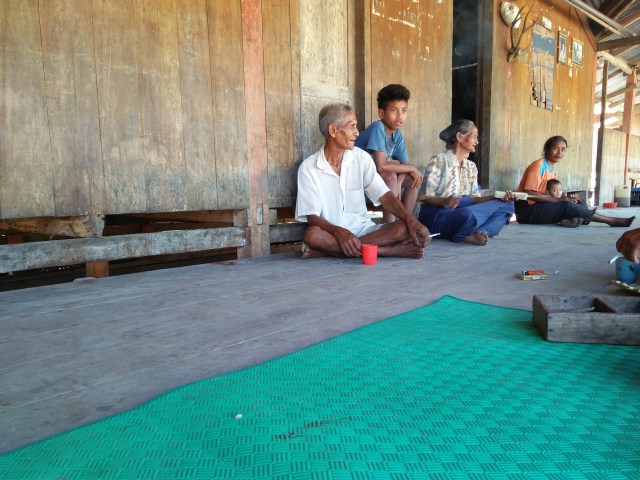
60kms of sad palms, dusty fields and bougainvillea, and I pull the bike over in Melolo at a favourite little warung of mine. I park in the shade, peel my helmet off like it’s a suction cup and wander in for a hot sweet tea. The sweat runs as the sugar hit begins, and I sit there, a pungent river in a parched and weary land. I begin a three-day reflection on how folks ever survive out here with distant water sources, seasonal crops and little, if any income. It’s certainly not by being lazy, uneducated, ignorant, inefficient or any other labels the poor are granted by those who scored better in the lottery of birth. A few mistakes is a death sentence in this kind of climate. There’s little room for error.
It takes a mix of numerous things: tenacity, a thorough knowledge of local resources that can be drawn on for survival when the crops fail, perseverance in the face of hopelessness, the discipline to ration meagre food and water supplies though your belly and your children beg you to do otherwise; it takes incredible grace and tact to preserve relationships with family, friends and money-lenders who might need to be drawn on should the ugly beasts of illness or famine make the short distance over the threshold and into the bodies of your loved ones; and it takes incredible wisdom to navigate all these things with an empty stomach and a malnourished mind.
And despite all that, they downed tools and plied this bule with coffee, rice and chicken they can’t afford to share; gave him the double bed with the only mosquito net in the house, extended grace to cover his cultural blunders and kept him shaded, watered and befriended ’til he decided to leave.
I’m beginning to understand – in a very tangible way – that thing the apostle Paul said about God using the ‘foolish’ to shame the ‘wise’; the ‘weak’ to shame the ‘strong’; that thing that Jesus said about our meeting him whenever we help the poor. And as I fled the heat on the fourth day, I had 60kms of branding asphalt to reconsider some long-held assumptions about exactly who is helping who; who is teaching who, and my place in it all.
If you want a comfortable life comrades, take my advice and don’t mingle, don’t get near, and don’t ever make friends with the poor.
It’s devastatingly transformative.

Posted in Uncategorized | 4 Comments

Moonlight conversions

I’ve visited this particular village before – a few times actually; it’s the home of the hypothetical Mrs. Maria.  But every other time I’d visited, it was to assess the suitability for a productive garden, the possibility of a hydram installation, monitor the garden – always with a specific task in mind that upon completion, saw us swiftly exit the village and proceed to the next.

This time was different, though I came with the usual task.  My flight didn’t arrive ‘til after lunch, so the sun was disappearing by the time we bounced our way over the final three kilometres of jalan batu – rocky road – to the village below.  I had been told that there was an issue with the hydram that wanted looking at, but by the time the usual pleasantries and expected istirahat (rest) were complete, it was too dark to descend to the river bed below for an appraisal of the hydram.

So we sat there, my co-worker and I, and the two hosts who had welcomed us.  And a strange thing happened as the darkness enveloped us: we sat in the same seats, in the same clothes, with the same faces and voices, barely moving an inch, but somehow – somehow – we shifted (if only a little, but a significant little) from organisational staff to village friends, moved a little down the continuum from professional outsiders to family.

And as the metamorphosis took place, that circle of four in the moonlight slowly grew, and its growth was reflected in the stories and the laughter, ‘til there were eight of us yarning and laughing and sharing strong opinions about politics and gossip and the inner life of a hydram.  And for a moment I almost belonged in a culture that is not my own in a place so far from home.

And so I asked the moon how he did such a thing under the cover of darkness.  But he doesn’t speak much.

__________

I woke early on my mattress in the schoolroom to the sound of dogs and chickens and children outside my window.  I rubbed sleep from my eyes, packed up my mosquito net and wandered down to the hydram below, where, while we worked on the pump and nutted it out…

…a little of last night’s conversion lingered.

Posted in Uncategorized | 3 Comments

The road and back to Ngonggi

Reflections on an 8 hour, 120km-round motorbike ride from Waimarang to Ngonggi in Eastern Sumba


For the joy that filled my heart, as I awoke beneath the net,

And pondered the day’s journey that lay out the creaking door,

Out, up through winding mountains, past the reach of signal towers,

For the gift of the adventure, my heart it gave you thanks.


For the roads that clung to mountains, mingling clouds with asphalt mud,

As they played us, cat-with-mouse, up hills, ‘round every hairpin bend,

While the rain fell all around us, fog’s embracing arms so cold,

For the thrill of mountain passes, my heart it gave you thanks.


For the girl who cooked us lunch up in Kanangga’s hilltop valley,

While the rain continued on, and the coffee warmed our hearts.

She made those simple noodles taste like manna heaven-sent,

For her 14-year-old chef work, my heart it gave you thanks.


For the lady there in Ngonggi, who sent her children scurrying,

Fetching donuts for a stranger who’d already forgot her name,

Though she gave her every utmost, her coffee and her best chair,

For that lady you call daughter, my heart it gave you thanks.


For the flat tyre on the way home, that forced some rest upon us,

For the goats that gave their place in the shelter in the rain,

For the kindness of the road that led us home through dark and fog,

For these things, these moments fleeting, my heart still gives you thanks.

Yes, my heart still gives you thanks.

Posted in Uncategorized | 4 Comments

Trinitarian Organisational Relationships

My unit this past semester was on ‘Organisational Development’, a seemingly dry and dull topic.  I found it strangely enjoyable and challenging, but you are sworn to secrecy on that one.  We spent a lot of time looking at leadership and organisational relationships, and through that I became intrigued as to whether there is a biblical paradigm that can be used to shape culturally and contextually appropriate models of organisational relationships (including leadership).  The vast majority of material on biblical leadership that I read this past semester had unacknowledged Western undertones, cherry-picking Bible verses that suited the author’s preferred cultural approach to leadership.  I explored the idea of Imago Dei as a possibly appropriate paradigm for organisational  relationships across all cultures; Imago Dei being the Christian belief that humanity was created in the image of a Three-yet-One God.

So I attempted to bring four thoroughly disputed topics together – the Trinity, Imago Dei, leadership and community development – in one short paper, with nothing less than a solid dash of youthful optimism (being 30, I have only recently become a man by Jewish standards).  But my argument is fairly simple: if all people across all cultures have been crafted in the image of a relational, three-yet-one God, then perhaps Imago Dei may be a helpful paradigm for shaping culturally appropriate models of organisational relationship.  If your work involves organisational relationships of any kind (regardless of whether you work cross-culturally or not), this paper may be of interest to you.

As always, any critique or feedback would be helpful for me as I continue to consider what it looks like for me to serve in and with and through organisational relationships of various kinds across two very different cultures.

Have a read here: Imagining us as Imago Dei

Posted in Uncategorized | 1 Comment

Participating in the grand narrative

Last night was the annual Easter parade here in Kupang, West Timor, and I wanted to try to capture something of it before it fades from memory, because it’s a great Indonesian experience while also being a great point of reflection.

It’s huge – bigger than the Independence Day parade, I was told, an interesting fact in itself.  Over 100 local churches and youth groups put in their application to build a float depicting a biblical story from the creation account to the resurrection of Jesus.  Lined up in chronological order, the elaborately decorated trucks slowly wind their way down the hill, their creators dancing and singing, declaring the story in the dust and diesel fumes that follow.  There’s the garden of Eden, resplendent with live snake, and every classic story after – the exodus, David and Goliath, Samson – a personal favourite this year: a truck converted into the story of Jonah and the whale, complete with functioning water spout, and two features most folks miss when they read the story: a five piece band and disco lights beneath that heaving, monstrous tail (Jonah 4:3).  The music is loud, distorted, the energy of the youth flagging but incredibly sustained over the 15 km journey from hilltop to valley.  The streets are lined with people, the footpath so packed that it’s a squeeze to move down any section of the main road; side roads blocked by a sea of motorbikes.  The floats stop every few minutes to regale the crowds with stories, music and dancing, the biblical narrative moving ever towards the resurrection of Jesus, the grand finale.  Slowly, slowly goes the journey.

With delicious irony, we bail at the Babylonian exile, and wander through the streets towards the pasar malam to find some dinner.  We pass a worn-out trash picker sleeping on his sack of plastic bottles, a beggar twisted into cruel contortions by polio, and a five-year-old street urchin asking for a few rupiah.  I wonder if this trio know there’s a celebratory, dancing convoy two, three, streets away, telling the story of a resurrected Jesus, the rising kingdom of God, the putting right of wrongs. Were they invited to participate? Or do they find the story unbelievable, inaccessible?  Is two, three streets too far away to hear the music?  Their combined experience is a paradoxical world away from the bright lights, the colour, the story playing out down the road.

I’m forced to walk back to hotel post-dinner; the roads are all clogged.  I have no option but to walk with the floats, be a part of the flashing lights, the dancing, the grand narrative that winds its way down the hill to the valley below.  As I walk, my spirit is encouraged by the metaphor playing out around me; the unfolding journey that won’t be hurried juxtaposed by the brokenness I encountered two, three streets away.  We live in the here-not-yet, the occasional sweet taste of life-as-it’s-meant-to-be reminding us that the bitterness that lingers in the backwaters and the alleys of our world and our lives doesn’t belong here.

I was kept awake til after midnight, tired but relieved when the last story, that final word – the resurrection – eventually arrived.  But it did arrive. It did arrive.

This is the story I live for.


Posted in Uncategorized | 5 Comments

Self-portrait lesson with Mrs. Maria

Self-reflection is one of those tools that lies somewhere in the murky waters between the oceans of good and evil.  Too much concern about self feeds ego, not enough can let arrogance grow fat.  In my wanderings through Indonesia, I sometimes find myself reflecting on the quiet (and not so quiet) messages that I’m sending at a village level whether I intend them or not; the way that I dress, the places I stay, who I smile at, the use of wrong words, the frequency and purpose of my visits. While there is no particular Mrs. Maria living lewat Waimarang, she typifies your average village mother;  hard-working, tenacious, quietly concerned for her children.  A beautiful lady with a beautiful soul.

Location: Lewat Waimarang, Eastern Sumba

The only thing for certain is that I’m not sure about Pak Bule.  When he arrives, it’s unannounced, arms and legs perched spider-like on the motorbike.  Gangly, a bit awkward, is Pak.  We’re never quite sure what he’s come for, but he gives the usual greetings in Bahasa and drinks the coffee, eats the corn that we offer.  I know he’s here for something; orang mancung, the long-nosed people never come just to visit.  Only friends do that.  Sometimes the mancung come to purchase things we shouldn’t sell; our land and our weavings, our coffee at prices we know we’ll lose money on.  But how can we to say no when the bellies of our children beg yes?  Dance Maria, dance.

He wanders around the village, looking, pointing, writing things in a little black book, pasty, red-faced and sweating.  Is help or trouble around the corner?  Only time will tell.  He smiles at the children, nods at our questions, attempts an incoherent reply, and smiles again.  He pulls out two small instruments and asks for help.  He explains my task: write the number on the screen every five minutes.  Don’t miss a five minute marker and don’t move til I come back, he says.  I write the numbers down as they change.  What will bring good to our village – high numbers or low numbers?  If only I knew; then perhaps I could change them.  But I don’t, so I write the numbers as they rise and fall, just as Pak Bule said.  Dance Maria, dance.

Pak Bule comes back, all sweat and aviation glasses, sipping bottled water, chewing biscuits our children only taste at weddings.  He’s smiling,  says it might work.  What exactly will work, I’m not sure, but there’s a rumour going around already, talk of a kabun produktif, an income-generating garden for the village. Perhaps there is hope this time.  But many mancungs come with their special instruments and little black books; many mancungs make many promises, but it’s a rare promise and an uncommon mancung that ever returns.  And always the photos, always the photos, though we’re dressed in our worst and haven’t yet washed today. By that chilli plant Maria, pretend you’re tending it, yes, no, no, not there, crouch a little lower, yes, that’s it, and smiling, not looking at the camera, pretend I’m not here Maria, and smiling, ah, yes.  Perfect.  That’s good. One more. The donors will like this.  Dance Maria, dance.

But perhaps this mancung is different.  A facilitator comes a few months later and works with us to set up the kabun productif.  We build fences, pull rocks, trees and roots, plant seeds, fetch water, learn new farming methods, rising well before the sun to complete the extra work.  The garden slowly grows and begins to bear fruit, we harvest it and share the small income between us; the children might wear shoes this year.

Pak Bule returns.  The kabun is nearly empty at present.  He wanders up and down the empty beds, stops often and wipes the sweat from his sun-burned forehead.  He repeatedly says ‘this is good’, he nods, he smiles, he shakes everyone’s hand.  He treats us with respect, but yet he asks us to have the garden full by April. How can he do this?  Does he not know that between here and April stands acres of corn that want tending and harvesting?  Does he not know that the plants he suggests will rot in the ground?  His heart is good, but his mind is sometimes lacking.  We nod, yes, Pak Bule, we will do this.  Dance Maria, dance.

Oh Pak Bule, you’re a good-hearted man, but would you listen before you speak; would you ask before you direct; would you be shaped by us as we are shaped by you, will you sit at our feet as we sit at yours?  Must this be a one way street, another railroad to mancung goals, and the horrid depot of ego? Are we just another of your dancing bears?

I dream of a day when my feet will move without obligation, without weight or fear or hesitation.  A day when they can dance with joy unshackled, when they are lifted by the knowledge of enough food should crops fail, when they tap to the rhythm of my children playing full-bellied and schooled, when my feet cannot help but lift the dust with the skip of an inward smile, as they twirl and dance and sing with the fluidity that only freedom permits.

Which dance lesson will this garden be Pak Bule?

______________________

Maria, your paintbrush follows only the truest of lines.  Forgive those patches of black and the grey; help me bring life and colour to those darker sections of my life’s canvas.  And may you dance Maria, may you soon dance to the tune of your own joyful making, for this too is the desire of my heart and the colour beneath my skin.  In this we are brother and sister.  Look closely, Maria, for though that pigment may be hard to see at times, it lies there deep beneath the camouflage of aviators and those spider-like arrivals.

May you dance one day soon Maria, may you dance as you do in your dreams.

Dance Maria, dance.

Maranatha.
 

Posted in Uncategorized | 5 Comments

Holey theology and the poor

Here’s a second essay that I was permitted to set the topic for.  The unit was on contextual theology, and I explored some gaps in Australian Evangelical theology that have contributed to the perpetuation of poverty, and suggested that Aboriginal theology may be helpful for plugging those gaps and deepening the Australian evangelical concern for the poor:

Gaps in Australian Evangelical Theology

Fear not, there won’t be another one for another six months 🙂

Posted in Uncategorized | Leave a comment

Yelling at God about poverty

As some of you are aware, I am currently undertaking my masters in transformational development.  For each unit, we’re required to set our own major essay question, which has been a great opportunity to explore topics and questions that arise through the study.  I thought I’d post the essays up here as some of the topics might interest some of you.  Others will certainly be bored by them, but it should be pointed out that 20-odd pages makes for a sizable fleet of electronic paper airplanes for the origamily equipped…

Here’s the first, exploring the potential contribution of the spiritual practice of lament to the community development context:

Yelling at God about Poverty

Posted in Uncategorized | 8 Comments

What hangs on the end of the chain

Between the care we give and the folks it assists often lies an ocean or two, our love passed hand-to-hand across the waters, traversing borders without visa or passport.  We all participate, you and I, in our different ways: folks fundraising, directors and donors, advocates, computer geniuses and cleaners keeping the offices of the local NGO ship-shape.  So many people, so many skills, most times unaware that we are actually one other’s co-worker.  And there’s those few, right at the end of the chain, who are truly walking with the poor; the staf lapangan, the field staff.  A whole lot of glory perhaps, but a whole lot of hard, gritty work.

Part of my role involves visiting these folks to see how they’re going, to see if the stories back at the office and across the waters haven’t had the truth bounced out of them on the long and pot-holed road home.  These staf lapangan do incredible work in difficult situations; living somewhere between the hopes and plans drawn up in the kantor pusat, the head office, and the hopes and plans of the folks they’re meant to help; attempting targets, goals, benchmarks, timelines and programs in complex cultural situations where due to their age, education or sex, they often hold little sway with the folks they hope to assist; working rural, living away from family and creature comforts so that they can live in and among the people they serve.  No easy job.  No easy job at all.

And so I visit for an hour or two, then retreat to the air-conditioned hotel and wifi and attempt a blogpost about the things I’ve seen, though an hour or two never made anyone an expert on anything.  And the staf lapangan return to where they came from and carry on with their job, memories of them quickly erased from the small minds of big picture people like myself.  Yet the entire success of our combined effort (yours and mine) hinges on these folks and the work that they do.

And so remind me often:

Jangan lupa orang kecil, Pak Klinton: Don’t forget the little people, Mr. Clinton.


They’re not that little.

And they’re people.

Posted in Uncategorized | 4 Comments

Billboard vs. whiteboard

I’m currently undertaking a Masters in Transformational Development through Eastern College (formerly Tabor Victoria), and am required to attend a week-long intensive every semester in either Melbourne or Kuala Lumpur.  This past week I joined the international students in KL:

We’ve spent the last two months doing set readings on contextual theology, weekly skype meetings with our cohort.  We’ve gathered in the conference room at Malaysia Care, right next to Chinatown with its culinary delights and tightly-packed market stalls.  I count thirty people, spread across thirteen countries.  Steve Bradbury, TEAR-turned-Micah Challenge Director and course coordinator asks, pen in hand, for any unresolved questions that we’d like answered this week.  He fills a large whiteboard.

We sit under some great Asian teaching, my Western mind poked, prodded, my cultural assumptions partially demarked.  I meet an amazing bunch of community development practitioners; a pint-sized middle-aged woman, sweetest person you’d meet, loves a laugh – tear-gassed four times for protesting against corruption in her country; a 70 year-old who is full of life, and pours it all out serving the homeless addicts in his city; folks working in difficult, remote terrain, others in situations of violence.  I hear so many amazing – and a number of terribly sad – stories, the week filled with a mix of passionate discussions, shared meals, the floating of ideas and questions, market wanderings and the dishing out of encouragement.

Soon enough it’s Friday.  I take a midnight flight home, kept awake by a personal whiteboard of queries that follow me home, no eraser in sight.  Touching down in Perth, I turn on my phone to three messages from friends wrestling with big questions.  I have a wife and three kids that I miss, an assignment due soon, Indo again in two weeks, teaching at the Churchfreo gathering tomorrow morning.  I groggily stumble past a billboard trying to get me to purchase an adventure somewhere in Africa. I grin and politely decline.  Attempting to participate in the kingdom of God is a wild enough journey for me.

Today, for some strange reason though, I’m up for it.

Posted in Uncategorized | 2 Comments