We climb the hill, and pass a goat hanging in a tree. My occipital lobe (somewhere in the back of my head) tells me goats shouldn’t be this acrobatic. We greet the two butchers and their 5-year-old apprentices; this is home-schooling, rural Sumba style. There’s a most handsome fellow tied to a nearby tree, a rooster I believe, and he’s making lunges at his rope. He eyes me with a hopeful glance, but I apologetically shake my head. Sorry pal. No chance.
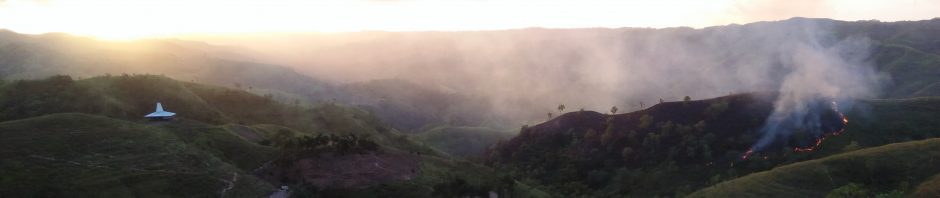
We march on up towards the spring. There’s a clearing to the left where a temporary kitchen has been dug into the side of the hill. A number of women stirring large blackened pots over open fire, gentle chatter and occasional laughter. Some young girls disappear into the scrub and return later bearing yam-like goodies. A little higher, to the right of the track we pass a large woven mat which is empty but commands a view of the valley below.
We keep climbing. There’s a pile of sand that looks out of place on a clay mountain, a pile of rocks further up, then a pad where cement is being mixed by hand, just across the way from our quarry; the spring box header tank. They’ll capture the spring further up, pipe it down to here, then send it onwards to the village below.
They’ve dug the header tank into the side of the hill, shovel free. Shovels just clag up with the clay. It’s all sticks and bare hands here. No other way really. Three cubic meters of tree roots and rocks glued together. It seems it can’t be that hard; there’s too much laughter for this type of work. But there’s plenty of sweat and grunting too, plenty of cigarettes and steaming coffee brought up from the camp kitchen below, plenty of guttural, soft-edged Bahasa Sumba, local dialect. I squat and take it all in.
Later they invite us to share a sumptuous meal on the mat, the youngest 7 months old, the oldest doesn’t remember his age: atas lima puluh, somewhere upwards from fifty. Between sips of goat soup, bites of roast chicken and their particular sambal – a green chilli and salt mix – I reflect on what’s taking place here. Technically it’s an Amos Aid project. But hardly. We’d call it what – a community gathering? A feast? Hard labour? Family reunion? I’m not sure. Perhaps all of them.
Later we leave, and I pass what remains of my arborist friend the goat. My occipital lobe has had a good workout today. I’ve seen a few things I thought weren’t possible. Acrobatic goats and a community that thrives, laughs and celebrates when they face a mountain of gelatinous roots and rocks. How do they do that?
Teach me, dear friends.
 patmos
Thanks heaps Clint, your stories make it just like being there.
Priceless! Thanks Son!
Proud to be your grandmother,Clint!
Unbelievable,we have a lot to learn!
love,oma.