I spent last week in Malaysia, rounding out my studies considering all things economic. As always, the world is much bigger (and stranger and scarier!) than I’d previously thought, and there are some intriguing alternatives to the dominant economic narrative we tend to hear in the Australian context. One thing in particular struck me as I listened to the teaching and insights of C.B. Samuel: I have a lot of work to do before my understanding of biblical stewardship and my penchant for private ownership are reconciled.
I mean, ask any half-baked evangelical as to how they’ve obtained their wealth thus far, and you’ll likely get a reply along the lines of ‘it’s a blessing from God.’ And I’d agree. If I’m really honest, I can’t really claim ownership over the things that I ‘own’ because there’s been too much input from others. I can’t ever return the vast resources my parents, family and friends have put into my life; I can’t return the sunshine that grows my veggies or repay the trees for cleaning the air I need to stay alive; I can’t trade my particular talents for others or buy more on eBay. In short, my existence is a gift from a holy trinity of sorts: without others, the earth and God, I’d be nothing and have nothing. What I am and ‘have’ is a gift entrusted to me.
However, between my understanding and practice of stewardship – the task of carefully disbursing what’s under my care – there seems to be a space about as wide and as smoggy as the Malaccan Strait (which we also visited last week). I talk about stewardship of God’s resources, but then go on to describe my finances, gifts and resources using first person pronouns (c.f. the sentence just gone). Consider the dichotomy I live: I’d never allow our Church treasurer to keep the annual income and expenditure under wraps even though she’s my lovely wife who I trust. Her job is to ensure that the funds under her management are tracked and disbursed along the lines of our vision and mission – and we hold her accountable to that task and audit her work every year. We do this because we know that money without accountability does funny things to a steward’s head and habits. But the resources (financial and otherwise) given and entrusted to me? Well, apparently they don’t need tracking or auditing. They don’t muck with my head or my habits. You can trust that I’ll disburse the whole lot in keeping with the vision and mission of Jesus who I claim to follow (c.f. Lk. 4:18-19). [Insert the gentle waft of a sewer rat].
Ahem.
Allow me to give you one very real (and hopefully concerning!) example that occurred to me in these last few days. My wife and I are planning to build a house in the next year or so. We estimate that we’ll spend about $250,000 on it – a huge sum of money – all of which will be loaned. The house will be made from the earth’s resources and will contribute a bunch of landfill even if we make considerable efforts to reduce the amount of waste generated. The debt will necessarily limit how much freedom we will have in terms of giving of our time and money to others (the bank will help us to make sure our repayments are our highest priority in life). Not only that, building a house throws up numerous temptations like greed and pride (how big, what colour, what will people think?). So this decision will necessarily impact all those we are inextricably linked to – God, others, and the earth. Yet in the Australian context, we are permitted to make this decision entirely on our own without having to give account for how it aligns with God’s desire and design for humanity and the earth we share. Doesn’t that strike you as peculiar and a little disconcerting?
(To be clear: this could be extrapolated out to any situation where we are disbursing the wide range of resources under our care – from daily spending habits to the why, what and for whom of our consumption).
C.B. Samuel pointed out that Jesus spoke about the dangers of money an awful lot while his modern followers don’t; in fact, C.B. went to argue persuasively that money is a spiritual power (it’s not evil, but it has undeniable power – and which other power would we ever argue is best left unchecked?). If either of those statement is correct, then why do I want to remain behind the safety of the taboos we’ve created around wealth? How might I transition from the lense of ‘my shi**’[1] to a biblically grounded and lived ‘stewardship’? How might we hold each other accountable to the task of disbursing the gifts given to us towards ‘the restoration of all things’? How might we do that in a way that is grounded in love and grace, producing Spirit-shaped fruit and avoiding the creation of laws and coercion and guilt?
I don’t know, but I’m happy to be a guinea pig.
So help me friends: I need your wisdom, gifts and assistance. Again.
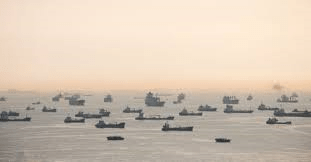
[1] Ships. Of course.
 patmos
aaaah ….. the tug ‘o war between what we want and what God wants …. and the warfare within! Perhaps there are no prescribed answers; only an honest heart before God will reveal what it is that we must do. (Thanks for this challenge, mate)
Hey Dad,
Thanks for your thoughts and reflections – and you’re right, there’s no quick or easy answers. If I can push back a little on the idea of sole accountability to God – if that’s what you’re suggesting (while fully supporting your idea that an honest heart before God is a good starting place!!): the contemporary and historical Christian community has found various ways of holding each other accountable for different temptations in a helpful way, which suggests to me that there may be ways that we might also be able to do the same with the risks and dangers inherent in ‘our’ finances and other resources.
But I might also well be wrong; I probably need to do some more reading/learning and practicing before holding too tenaciously to the idea that its possible – and I should start with my own life before critiquing or expecting the wider community to do things differently. Anyway. Thanks for reading and responding, and I’m looking forward to seeing you again soon, it’s been a long time – we’ve enjoyed it here – but we’re about ready to come home and see you all again…
Love,
Clint.
Yeah … mutual accountability could be useful, I’m sure, Clint. Looking forward to seeing you all back in Oz!
Thanks again for this! When we lived in PNG i felt like we had a bit more accountability with resource things. It was good! I also know that i love having peoples approval for things so accountability can also kind of degress into a yay-people-think-im-good thingo. But that doesnt mean accountability should be avoided!
Yes and yes! It will no doubt be messy with mixed motivations – as I find happens with most good things I attempt to do! I’d be keen to hear more from you at some point as to what was different about the context of PNG that allowed greater accountability. Anyway, thanks for having a read and engaging with it!