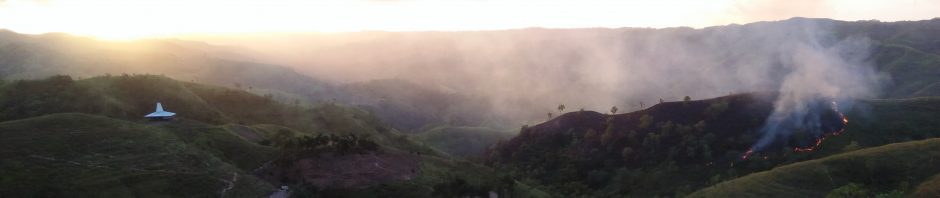
I’m on the plane home after spending this past week travelling Eastern Sumba with a few of the other Amos Australia folk – Jake, Arlene (staff members) and Diane (board member). I’m looking forward to being home and the ‘number and highlights’ chat we often have around the dinner table. Each person picks a number between one and three to indicate what sort of day they had (one is a sad day, three is a happy day, two is a bit-sad-bit-happy day). If you’re lucky and ask nicely, sometimes you’ll be granted more than one highlight.
I’d say my week was a number three, hands-down: lovely travel companions, encouraging visits to partner organisations and a clearer sense of where things are at and what’s next. But my highlight for this week was spending the night with the community in Prai Hambuli, Eastern Sumba, a place that can only be accessed by motorbike (or 4WD) when the weather is dry; any rain and you’ll slide down one side of the valley, and never get up the other.
As usually happens when I’ve visited rural communities in Indonesia, our arrival interrupted their work – they were clearing a path through the scrub for the impending delivery truck – but they downed tools and kept us filled with food and fresh, sweet coffee until we left the next day. I attempted to learn a bit more Bahasa Sumba – ngutah laku la mata wei (let’s go to the spring’) and ngangu uhuh, unung kopi (‘eat rice, drink coffee’ – four key words on a rural Sumbanese menu). We walked down to the spring, a 1.2km round trip down a deep valley that our host currently travels three times a day to keep his family hydrated. There’s so much I loved about staying with that community – the landscape, the generosity, the tenacity, the adaptability and patience of the people, the lack of mobile phone access.
But my second highlight (if I asked nicely, and if I was lucky enough for it to be permitted) would have to be meeting Ibu Ifa, one of the teachers at the community school. Originally from Makassar, I asked why she came here – it wasn’t her choice, she was quick to reply, she was posted here for five years by the education department. The first time she tried to visit the village, the access was too difficult and dangerous, so she went back to the main town and tried again a few weeks later. She said that when she finally arrived, she cried every day for the first week – it’s so remote, so different and difficult compared to life back home; no running water, no electricity, no internet access or the company of family and friends, a new language, monotonous food. She’s made a little bedroom in the corner of a classroom, and keeps her parents from worrying about her by talking up her situation, being careful about which photos she sends them, and declining requests by them to visit.
But she moves and speaks in a way that suggests she’s not just here to bide her time, but to serve the 40 or so students under her care with everything she’s got. She speaks gently about the kids, empathically about the community, and angrily about the education department who are slow to send supplies and haven’t visited in two years because of the difficult access roads. She tells us about another teacher who had been posted to help her, but he didn’t even get as far as the turn-off before he legged it home again – a common story I hear about teachers and nurses in rural areas (and I would probably do the same!). She speaks firmly about these things, saying ‘if I can do this as a young woman, why can’t he?’ Fair question.
When I asked her why she doesn’t run away like the others have, she gave a little shrug and said, “It’s what’s been assigned to me, this is my responsibility, and I need to do my bit for this country,” which I have a hunch was a significant downplaying of what drives her. She could run away, as so many others have. But she’s chosen to stay and serve the children under her care despite the overwhelming conditions. She seems utterly determined to serve teach them as best she can with the little resources she has.
I’m not sure that I’ve captured her presence very well. People like her are hard to describe – you can’t pin down what it that is so attractive about them. It’s not just that she’s chosen to stay, it’s not just that she speaks gently, it’s that her whole posture and being has a presence and purpose about it; there’s a deep integrity about her, a loving, generous hopefulness towards the world that permeates everything about her – the way she speaks, the way she interacts and carries herself.
And so I found myself encouraged and challenged by Ibu Ifa. It’s easy for me to spend one night of restless sleep on a bamboo floor and then head home and share a story. It’s far more difficult to stay in a community for a number of years – enter the relational complexity there, live and breathe rural village life, be the target of every complaint against the education department, teach hungry, tired and distracted kids, and do all of that with a posture of grace, love and humility. I found myself wondering how I’d hold up under those circumstances – I’m not sure I’d end up serving with the heart that Ibu Ifa does.
So if you’ve got a minute, maybe offer a prayer of thanks for Ibu Ifa, and the many, many folks like her who willingly serve with love in far-flung places. They do it knowing they’ll never receive acknowledgement for it, and they often do so in very difficult circumstances. But it’s folks like Ibu Ifa that this world needs more of. Perhaps we don’t need super heroes or international programs as much as an uprising of Ibu Ifas who are other-oriented, gracious, and gentle. People who personify so much that I love about the teachings of Jesus.
If you read this again,
Would it change anything,
If you pictured her
Wearing a hijab?

Photo courtesy Arlene Bax
 patmos
Ibu Ifa …an inspiration to me! Cheeky little challenge at the end regarding the hijab …. a reminder that perhaps we forget that all of humanity is created in God’s image and is in need of restoration …. and therefore is worthy of our love!
Haha! And Yes! I think the reflection for me as we left Prai Hambuli was that when I think of people that I think capture something of Jesus’ teaching, I typically conjure up someone who looks just like me (unfortunate, I know!) – but I was reminded of the parable of the Good Samaritan who reflected the key to God’s law even though he was despised by the dominant culture that Jesus was teaching in. So the cheeky challenge came first from my own reflection, and I thought others might find it an interesting point of reflection too – I hope it didn’t come across as a poke in the ribs… Love ya Dad!
Clint, this post brought tears to my eyes. You describe so well the servant spirit that inhabits this young teacher, and what Jesus modelled for us!! Thank you for writing it, it brings me a lot of joy to see others witness the greatness of the ‘little people’ who make a real difference in the world. Keep it up, friend.
Hey Ana,
Thanks for your kind words and encouragement – it means a lot to me. I hope that you and Grant are well – please give him a big hug from us, we miss you guys, but are thankful for the time we had together. And yes – I do think there are so many ‘little people’ doing great things, and perhaps I need to hear/see/find more of them, as it’s typically the nasty ones that make the news, but it’s the one likes Ibu Ifa that make me think and make me hopeful. All the best with looking after NZ, and please let your lovely prime minister know that she is welcome to invade Australia anytime…
Thank you Clint,for your enthusiasm and update!
Get Outlook for Android
________________________________
Hey Oma,
Thanks for stopping by and having a read! I hope you and Keith are well…
Much love,
Clint.