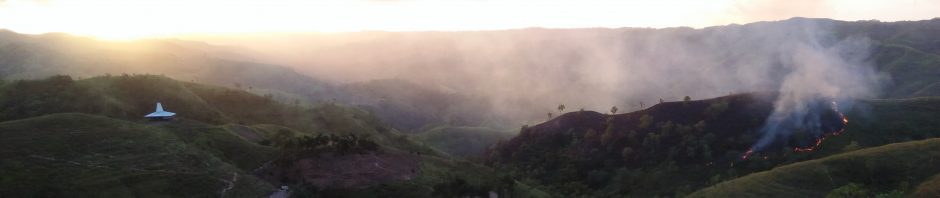
It’s very common – almost standard fare – to arrive mid-morning at a village in rural Indonesia and be greeted by a porch full of people. Space will be made for you on the woven mats, coffee will be poured, and snacks, meals and slow conversation will be shared in the hours that follow. People will wander in and out, but there will often be a steady presence of community members until you leave.
This is quite a sharp contrast, a very different experience to dropping by a friend’s house here in Australia. In my hometown of Fremantle, there’s generally no ‘dropping by’ – it will normally be pre-arranged, and almost always in the evening or outside of work hours.
I remember sitting on a front porch in rural Indonesia, and around the third hour in, wondering why all these people weren’t working at midday. I couldn’t help thinking that perhaps this sitting-around-drinking-coffee-all-day lifestyle might be a key contributor to their economic poverty. I couldn’t help thinking they were, well, a bit lazy. I have a hunch I’m not the only Australian to have had this midday reflection on a rural Indonesian porch.

And the evidence seems to support this idea. Australians are always busy (‘How are things?’ ‘Yeah, busy…’), with packed schedules and long work hours. If there is a blurring of work-rest boundaries, it’s almost always work interrupting our down-time, and rarely – if ever – leisure interfering with work hours. We’re a wealthy country and people work long hours; surely there’s a correlation there right? In Australia, sitting on your porch with a bunch of mates for hours at midday won’t make you rich, will it?
And further, if everyone has ‘sinned and fallen short of the glory of God’, the economically poor are also sinful, prone to gluttony, laziness and so on. And as people remind me from time to time, there are passages of Scripture along those lines: ‘Go to the ant, you sluggard’ (interestingly, there are significantly less of these passages compared with those calling the rich to act more justly).
Are the poor lazy? Well, like many things, it’s a little more complicated and layered than that. Sure, some economically poor people are lazy – that’s inevitable; no group of people are exempt from indolence. But odds are you’ll find many more lazier wealthy people than lazy poor people; procrastination and idleness are luxuries that most economically poor people can’t afford. Can’t be bothered doing the physically intensive work of planting crops and tending them in rural Indonesia? Odds are you’ll be indebted and hungry come the dry season. Can’t be bothered doing the physically intensive work of planting crops and tending them as a wealthy person in Fremantle, Western Australia? Odds are you’ll browse air-conditioned aisles of a nearby supermarket for whatever it is that you feel like eating, whether it’s locally grown, in season, expensive or not. Actually, you’d order Uber-eats right?
The reality is that the rich have much greater opportunities for laziness in its variety of forms. Conversely, the poor have many more pressures and factors that leave them no option but to work hard; no electricity, no running water, no shopping centres, little-to-no income. Laziness in that context risks an early death.

So what’s going on with these extended midday breaks on rural Indonesian porches? Well, context is everything, and there’s a few possibilities – I’ll just share one.
It took me a few years to become aware that my arrivals were pre-arranged, often weeks in advance – such is the gentle, subtle nature of Indonesian hospitality. I had thought we’d caught porch-sitters unawares, but I was the ignorant one. They were ready and waiting – with food and drink they wouldn’t normally have – to greet ‘the stranger in the land.’ They’d adjusted their workload around my visits, and would play catch-up in the days before and after my arrival. But to have a visitor arrive with no-one to greet them would be unacceptable, terrible hospitality. Instead, they’ll down tools to create a welcoming space, and hold that space for as long as the visitor stays, regardless of the pressure of work that needs doing. Hospitality trumps outputs, daily targets or to-do lists in rural Indonesia.
Are the poor lazy? Sure, some of them are – but they’re very much in the minority. And a porch full of villagers in rural Indonesia is not evidence of that, although first glances suggesting it might be. Rather it is reflective of an incredibly gentle, hidden and generous hospitality that challenges not just my own notions of generosity, but also my tendency to value maintaining strict work hours over relationships and hospitality.
So I’m learning that even despite plenty of time spent abroad, odds are I don’t entirely know what’s going on when I’m in a cultural context that isn’t mine.

Which makes me wonder how wildly inaccurate my conclusions and assumptions are in my own cultural context. Do I have a better handle on what’s happening because I’m familiar with it, or does my familiarity give me a particular blindness? What’s really going on behind the cardboard signs requesting assistance on the sidewalks of Fremantle’s café strip? What’s the real story – not the one I’ve constructed as I walk past? And not just what’s the story, but who is the person behind that sign?
I have a hunch that only time spent together on a proverbial porch sharing coffee, snacks and slow conversation will begin to uncover the beauty, the suffering, the brokenness and the gifts in both of us.
And who knows what might be discovered and develop? In my limited experience, it’s often those who are the most different from me who have offered the richest, most interesting and challenging insights for me to ponder.
This will be published in the upcoming Amos Magazine – if you’d like a copy, and you’re not already on the mailing list, let me know and I’ll make sure you get one!
 patmos
It was good reading this story over again…but not just reading. Thanks for the perspective of others and how quickly we can judge without really knowing. Wishing all your readers love for others in 2023.
Food for thought!I’d love to know what others think!
Like light dancing on water, your Spirit inspired musings are bright and real!
Oh that’s kind of you Ursula! Hope you and Colin are well – make sure you drop by if you’re ever in Perth!